Investor profile
Type of capital, horizon, involvement and the ownership outcome the shareholders can accept.
Investor search
Producing a long investor list is not the objective. The objective is to establish which parties have a credible strategic or financial reason to look at this company, in this situation, at this moment — and to reach them directly.
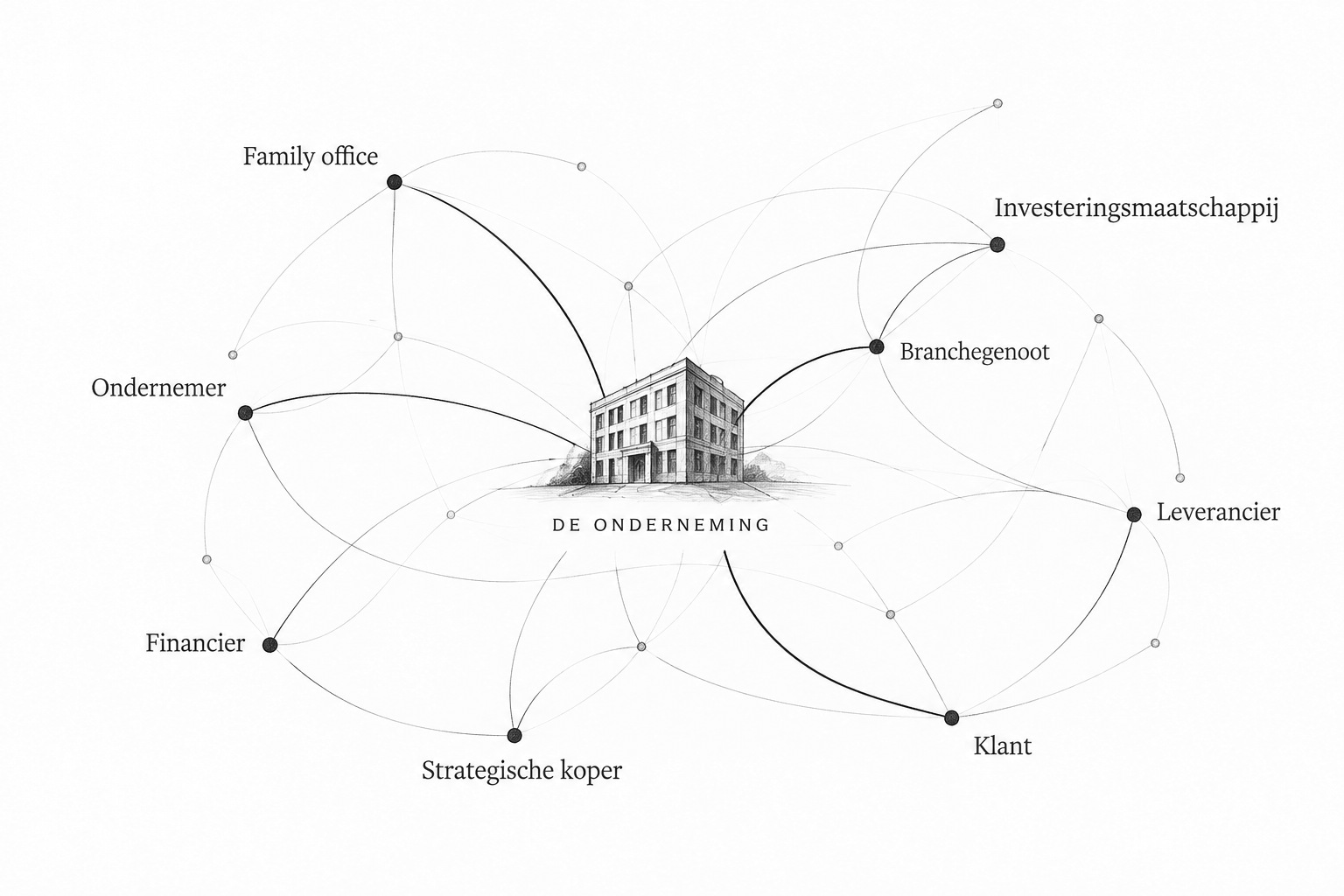
Why investor relevance matters
Capital is available. Attention is not. Investors see far more opportunities than they can assess, so the decisive question is not who has money, but who has a reason to spend time on this company.
An investor who already understands the sector, the customer base or the business model reads the same information differently. That is why a short, well-argued list of relevant parties usually produces more conversations than a long list of plausible ones.
Who may be relevant
Relevance is rarely limited to one category of capital provider. Depending on the situation, several different profiles can make sense for the same company, each with a different consequence for ownership, governance and horizon.
Family offices
Private equity investors
Growth and expansion investors
Strategic corporate investors
Entrepreneurs and informal investors
Specialist and alternative financiers
International investors with sector focus
MBI candidates investing alongside management
From investor universe to shortlist
The search narrows in steps. Each step removes parties for whom the opportunity would not be defensible internally, and sharpens the argument for those who remain.
Type of capital, horizon, involvement and the ownership outcome the shareholders can accept.
Whether the structure, timing and use of proceeds match how that investor typically works.
Existing knowledge, portfolio adjacency or commercial exposure to the same market.
Whether the capital requirement sits comfortably inside the investor's normal range.
Early development, established growth or transaction-driven situations each attract different parties.
Dutch, European or wider, depending on where the rationale is strongest.
Direct approach
Once the shortlist is set, parties are approached directly and discreetly, with a specific reason why this company could be relevant to them. No broad distribution, no open marketing of the opportunity.
The objective of the approach is a serious conversation between the entrepreneur and a party that has already understood why it is being contacted.
Dutch companies, international capital
Capital Search works from the Netherlands with Dutch entrepreneurs and companies. The search itself follows the rationale: sometimes it stays entirely domestic, sometimes the most relevant investor sits in Germany, the United Kingdom, the Nordics, North America or elsewhere.
For international parties, a Dutch company is often an entry point into a market they already want to reach. That is a rationale worth testing before assuming a domestic search is sufficient.
Relevant cases
Anonymous investor search mandates across different sectors, stages and geographies.
A quarry in Africa required capital for further development. The search extended beyond the obvious Dutch investor universe to parties for whom the asset, geography and opportunity had strategic or financial relevance.

A bio-pharma company sought investing strategic partners offering market access, technology, distribution, sector expertise or complementary commercial interests.

A niche wellness concept in Amsterdam required funding and the right partner. The mandate focused on parties combining capital with a network, brand strength, operational experience or access to the target market.

Mental healthcare company seeking start-up capital for the development and roll-out of the organisation.

Questions
By working backwards from the company rather than forwards from a list. We establish what the company is, what it needs and why that could matter commercially or financially to a specific type of investor, then identify and prioritise those parties and contact them directly.
Yes. Many mandates involve parties outside the Netherlands. Whether the search is national or international depends on where the strategic and financial rationale is strongest, not on a fixed geographic scope.
Databases are a starting point for research, not the search itself. The work is in establishing rationale, prioritising and making direct contact with the people who actually decide.
Approaches are individual and discreet. The opportunity is not published or circulated, and what is shared at first contact is limited to what a party needs in order to decide whether a conversation is worthwhile.
A clear view of the business, the numbers, the capital requirement and what the shareholders want from the outcome. Materials can be developed during the process, but the underlying clarity has to come from the entrepreneur.
Related searches
Equity for Dutch companies entering their next stage of development.
Investors who add market access, technology or distribution to their capital.
Targeted identification of buyers for a Dutch company.
An initial conversation starts with the company, the situation and the kind of investor that would genuinely fit.
Capital Search is part of De Nieuwe Aandeelhouder. You can contact us directly through De Nieuwe Aandeelhouder.